
The security of medical data
Published on
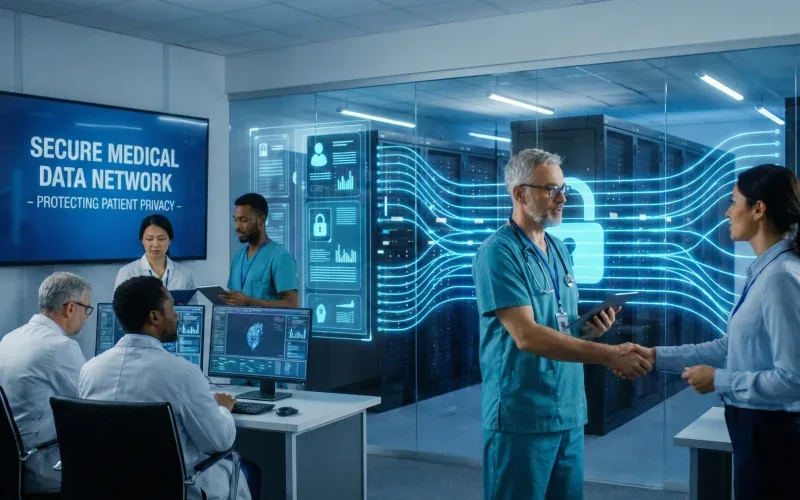
In today’s ecosystem, the digitalization of healthcare is no longer optional: it has become the engine of medicine that is closer to people and faster. Yet this progress brings an unprecedented technical and ethical challenge: protecting patient privacy.
Medical data is not just any asset. Unlike a bank password or a credit card, information about our health is permanent, unchangeable, and deeply personal. Losing it or having it tampered with doesn’t just compromise privacy; it can directly affect clinical safety and trust in the healthcare system.
As Head of Security and Compliance at homedoctor, I see cybersecurity not simply as an IT requirement or a legal formality, but as an extension of my commitment to care. Protecting data is, ultimately, protecting the patient. That’s why my team has built an ecosystem where medical innovation and regulatory rigor come together, so that your only concern is your well-being.
The legal and regulatory framework: beyond compliance
In digital health, security can’t rest on good intentions; it has to be anchored in international certifications and national laws that audit every process. At homedoctor, we operate under a "three-layer" architecture of trust:
The medical device guarantee (MDR and ISO 13485)
Unlike generic wellness apps, the homedoctor app is certified as a class IIa medical device under the demanding Regulation (EU) 2017/745 (MDR). What does this mean for patients? It means a notified body has confirmed that our software is safe and that we maintain strict quality control (ISO 13485) throughout the product life cycle. We don’t just protect your data: we look after the quality of the service that cares for you.
Excellence in cybersecurity: ISO 27001 and ENS
To protect information, we rely on the international benchmark: ISO 27001. But we went a step further to meet the requirements of the Spanish public sector, obtaining certification under Spain’s National Security Framework (ENS) in the MEDIUM category. This level of certification ensures that homedoctor meets very rigorous security requirements in terms of organization, people, technology, and facility protection.
Resilience against new threats: NIS2
Cybersecurity is dynamic. That’s why we are already aligned with the European NIS2 Directive, which strengthens the resilience of critical entities. It requires us to maintain continuous monitoring and the ability to respond immediately to any incident, so the medical service keeps running whatever happens.
Security by design (privacy by design)
At homedoctor, I make sure privacy isn’t a setting users have to switch on; it’s the default state of our technology. I apply the principle of "security by design" at every stage of building the homedoctor app.
An ecosystem protected end to end
When a patient uses the Monitor4, the Stetho digital stethoscope, or the CAM camera, a flow of health data is created. My responsibility is to keep that journey secure:
Encrypted communications: all communication between the devices and our cloud uses 256-bit encryption protocols (SSL/TLS). This ensures the signal (whether a blood pressure reading or an image from the CAM) travels privately and cannot be intercepted.
Secure software life cycle: following the IEC 62304 and IEC 82304 standards, our engineering team applies development methods that include constant vulnerability testing. Every app update goes through rigorous quality control before it reaches users.
Identity management: we use advanced authentication systems to ensure that only authorized medical staff, and the patients themselves, can access the information. Our engineers’ access to data is strictly limited, audited, and protected by cryptographic keys that are rotated regularly.
Patients in control
Under the GDPR, we’ve designed an interface where consent is transparent and granular. Users always know what data is being collected and for what clinical purpose, and they keep control over their digital medical history at all times.
Infrastructure and resilience: the strength of the data
For security to be effective, it must not only be hard to breach but also robust and available around the clock. At homedoctor, our infrastructure is designed to meet the demands of a critical medical service.
Data sovereignty and certified cloud
Our users’ data doesn’t travel over uncertain networks. We use the infrastructure of a certified cloud provider, in European Union regions. This allows us to guarantee two essential things:
GDPR compliance: data never leaves the European legal protection framework.
Physical security: our provider holds certifications such as PCI-DSS and SOC 1, 2, and 3, which ensures that the "place" where data is stored has very strict physical access controls.
Availability and business continuity
A healthcare system that isn’t available when it’s needed isn’t safe. That’s why we apply high-availability policies:
Redundancy: our systems are replicated. If one server fails, another takes over automatically, so doctors and patients don’t notice the interruption.
Encrypted backups: we make incremental, encrypted backups every day and regularly test restoring them, to make sure our patients’ history is always safe from any technical disaster.
24/7 monitoring and incident response
Following the NIS2 guidelines, we constantly monitor our APIs and systems. We have an incident response plan that lets us detect, isolate, and contain any unauthorized access attempt before it can affect the integrity of the database.
The human factor and data ethics
It is often said that people are the weakest link in cybersecurity. At homedoctor, we have turned that weakness into our greatest strength through ongoing training and uncompromising digital ethics.
A culture of compliance across the team
Security isn’t only the responsibility of the CISO (Chief Information Security Officer); it’s a commitment shared by every employee.
Medical training: our medical staff receive specific training on handling electronic health records and on confidentiality in telemedicine.
Secure development: our engineers follow OWASP best practices to prevent vulnerabilities from the moment code is written, so that every new feature of the app is protected from the start.
Transparency and patient ownership
For me, data ethics means recognizing a fundamental truth: your data belongs to you. In line with the GDPR, I ensure, as the person responsible, that patients have full control over their information. You can access, correct, or request the portability of your medical data at any time.
Data minimization: we only collect the data strictly necessary to provide the medical service. We don’t sell information or allow third-party access without an explicit clinical or legal purpose.
Audits and continuous improvement
Trust is built on facts. That’s why we undergo regular external and internal audits (in line with ISO 13485 and ISO 27001). These reviews ensure that our human and technical processes not only comply with the law but also evolve to anticipate the new challenges of digital medicine.
Conclusion: security as an enabler of health
Ultimately, the security of medical data is not an end in itself, but the essential means that makes digital medicine possible. Without privacy there is no trust, and without trust there is no progress in care.
At homedoctor, we have chosen to stand out not only for telemedicine and devices to measure yourself at home, but also for an unwavering commitment to compliance and cybersecurity. By meeting the most demanding standards, from the MDR and ISO 13485 to the ENS and ISO 27001, we don’t just protect bytes of information; we protect the peace of mind of the families who trust us every day.
My vision is clear: technology should be invisible and secure, so that the only thing that stands out is the quality of medical care. Because in the digital health of the future, the greatest innovation is, and will remain, trust.